
Science has easily shown that plants grow healthier and stronger when their caretakers relate to them with kindness. Water forms beautiful crystal patterns when exposed to the word “love.” We know children best grow and develop in a loving, encouraging environment. And even as adults, we never lose our need for the life-enhancing oxygen and fertilizer that is love in our lives.
The problem is that the vast majority of us, by the time we reach adulthood, have taken in a lot of negative messages about our lack of worth and lovability. We absorb these harmful messages from our families, cultural institutions, economic models, and religious traditions, until our own minds are colonized by an army of self-sabotaging beliefs. The field of our innate goodness becomes almost unrecognizable as these beliefs function like landmines we are constantly tripping as we gingerly try to keep alive whatever positive sense of self we can manage.
So how do we clear the field? What can help us to defuse these belief bombs that threaten our sense of security and value? Where is the rich compost from which we can nurture the insight needed to transform our relationship to self and others? Who can guide us in rediscovering our natural wisdom and warmth?
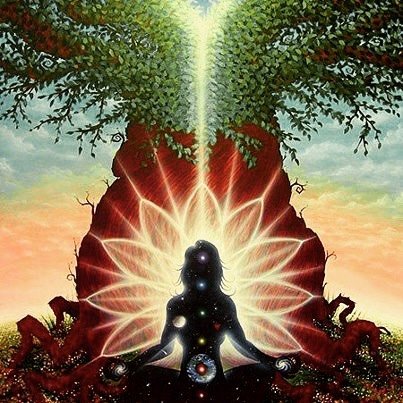
Nearly two thousand years ago Tibetan practitioners of Buddhist Tantra devised a powerful visualization practice known as The Jewel Tree or Healing Mentor meditation as one answer to these questions. To this day, monastics and lay persons take themselves through a series of steps to invoke a personally transformative relationship with their mentor or teacher, that is ultimately about healing themselves and, on that basis, healing the world.
“Deep personal and social transformation only happens in an interactive field of love. And the more we plow that field, learning to love ourselves and others with unreserved openness, the more we align ourselves with the vitality, passion, and purpose of the consciousness that wants to live uniquely through each of us.”
The basic steps involve dissolving the ordinary sense of ourselves and the world as we experience it. We then create in our imagination what Buddhist scholar Robert Thurman likes to call an ideal “buddhaverse” or mandala inhabited not only by a personal mentor or teacher, but also by a limitless number of awakened beings who also join us to offer their insight and caring concern for our wellbeing. We allow ourselves to bathe in this unconditionally loving and enlightened attention, not only from our personal mentor but also from all those who embody the qualities we want to cultivate in ourselves: wisdom, lovingkindness, courage, devotion, and so on.
In the practice, the loving relationship with our mentor transmutes our ordinary, neurotic, and habitual ways of seeing and reacting to our experience. This deepening connection with the mentor creates a super-charged field of wisdom and compassion that allows us to feel safe enough to acknowledge our flaws without shame, and to recognize the already present wakefulness inside of us that is just like the mentor’s. The practice thus begins to reveal and stabilize our bond with our own enlightened nature. From that basis, we activate our unique capacities to bring whatever insight and compassion we have gained to help others’ healing and ultimately to transform our world.
So you can see that even these ancient monks and lay people were dealing with the same issues we are! They drew on their intuition and creativity, using positive affirmations and visualization to manifest a better version of themselves and the world. In many ways the mentor represents the wise, all-loving parent we never had, and helps to heal the attachment wounds of our upbringing that keep us walled off from the truth of our basic nature—which is open and loving—and of our inseparable connection with others.
Deep personal and social transformation only happens in an interactive field of love. And the more we plow that field, learning to love ourselves and others with unreserved openness, the more we align ourselves with the vitality, passion, and purpose of the consciousness that wants to live uniquely through each of us.
These days we tend to think of positive affirmations and guided imagery as modern technologies for learning to love and care for ourselves. But the truth is these kinds of powerfully transformational practices have been around for as long as humans have been seeking to heal a sense of separation between themselves and the nature of reality itself.
This genuine—sometimes tender, sometimes fierce—longing to repair the perceived rupture between ourselves and our own awakened nature has compelled our oh-so-human species to invent a multitude of ways to cultivate our connection with unconditional love. Our hearts somehow know that nothing less than direct contact with the spiritual nature of all things, including ourselves, will satisfy this longing and allow us to be transformed in and by this loving and living relationship with the divine.